Project Introduction

Welcome to Campus Communities @ UDistrict
We are very pleased to announce the UDistrict Plan is moving forward on the edge of UFV’s campus in Abbotsford!
UFV Properties Trust (the “Trust”) is excited to launch its first neighbourhood at the Abbotsford campus of the University of the Fraser Valley (“UFV”).
Campus Communities @UDistrict will transform 5.7 acres of existing parking lots at the Abbotsford campus into a community with up to 635 homes at Lot 4/5 and 84 homes at Lot 2A available to the public.
The development plans will align with the City’s 2018 UDistrict Neighbourhood Plan vision to create a thriving complete community along King Road, and blur the lines between campus and surrounding neighbourhoods.
What Lands Will Be Developed?
Parking Lots 4/5 (33844 King Road) and Lot 2A (1508 College Drive) will be developed in coming years.
Together, these sites total approximately 5.7 acres and will be the first within the UDistrict Plan to apply the new “University Village” zone. The number and type of units developed will be driven by local market demand.
We anticipate the following maximum project sizes…

Northern portion of Lot 4/5
- Two buildings with up to 316 homes are anticipated including townhomes.
- It is also possible a commercial office “Innovation Hub” may be included in plans.

Southern portion of Lot 4/5
- A mixed-use development with up to 319 homes and townhomes plus 3-4 commercial retail units (restaurant, café space) is planned.
- A new “University Plaza” zone will be created blurring the lines between campus and the new community.
- Green space will be shared and “activated” with the community and UFV.

Lot 2a
- A residential building over a parking structure with at least 84 homes.
- Each residential home will have its own underground parking.
- This parcel is being explored for possible lower cost, more affordable housing options.

These projects are anticipated to be a mix of condominium and rental buildings (exact unit mix will be determined in coming years based upon market need).
All new projects built will have their own underground parking.
The project planned for Lot 2a will include both parking and residential units (any above-ground parking is anticipated to be owned and managed by UFV).
The existing parking of Lot 4/5 will be replaced through expansion of parking across a number of locations on campus.
Goals and Vision

This project is rooted in more than a decade of planning, including the UDistrict Neighbourhood Plan (2018) , the Design Guidelines , and the Community Design Guidelines (2024) .
It builds on years of visioning and public input to deliver:
- Housing that meets local needs
- A socially sustainable community welcome to all
- New green spaces and gathering areas
- Connections between campus and neighbourhoods
- A walkable and well-amenitized community
Other Relevant Documents:
Why Now?
UFV Properties Trust is putting plans into action. The proposed rezoning will support both campus and city-wide goals, while creating long-term financial returns that can be reinvested in UFV’s future, including educational infrastructure and student-focused development.
How We Got Here
Planning the UDistrict
The vision for this area didn’t emerge overnight. Since 2015, the City of Abbotsford and UFV have worked with residents, students, landowners, and community members to shape the future of the UDistrict. That work directly informed today’s plan and the development now underway.
Public Consultation Milestones
Stage 1 – April 2015
On April 8, 2015, the City of Abbotsford and the University of the Fraser Valley launched the UDistrict project. The purpose of the launch event was to raise awareness about the process and opportunities for involvement, communicate background research completed to date, and gather information from participants to inform concept options. The event was promoted by over 1,600 postcards, posters, newspaper advertisements, radio announcements, e-newsletters, and social media. Open houses were held at UFV in front of Abbotsford Centre. For those who were unable to attend the event in person, a questionnaire was made available on the project website.

Stage 2 – October 2015
Stage 2 open houses were held on October 15, 2015, at Abbotsford Centre and the Student Union Building at UFV. Advertising the events followed the same format as Stage 1, and once again an online survey was offered for those who could not attend the event.
Consultation focused on getting input on various design elements of the plan. Two different concept options were presented to the public, and they were asked to provide their comments on various design elements, which were centered on land use, mobility and open space.

Stage 3 – February 2018
Stage 3 public consultation took place on February 6th, 2018 and open houses were held at Abbotsford Centre and the Library Rotunda at UFV. Both events were well attended, and advertising followed the same format as the previous stages. The presentation boards and the comment form were posted online for those who could not attend the event.
Engagement was directed towards receiving feedback on the draft plan, and determining if any last changes needed to be incorporated.

Throughout the process, the team met with strata councils, church groups, business owners, and other local community members.
A design charrette in June 2015 helped shape early campus and neighbourhood ideas.

Building Community
UFV has a strong commitment to building community, and the property trust has embraced this commitment in its plans.
Building Community: Although environmental sustainability has quickly become mainstreamed into the way we design buildings, social sustainability and community building is often not embedded into new development plans. We aim to change this. Neighbourhood and home design significantly impacts our wellbeing. Creating socially sustainable neighbourhoods will directly improve long-term lifecycle housing affordability, reduce social isolation, and help reduce our carbon footprint (e.g. through car sharing). We look forward to working with developers and partners to deliver on our vision of building community.
Gary Morrison, CEO, Campus Communities
Social wellbeing refers to the extent to which individuals and communities experience a sense of belonging, social inclusion, and overall satisfaction with their social relationships and connections. These connections include both casual encounters and deeper relationships with family, friends, neighbours, and the broader community. Social wellbeing is a core dimension of overall wellbeing, and is closely linked to mental, physical, and emotional health.
Realm 1: Neighbourhood

Realm 1 looks at how circulation, buildings, and open space work together on the site, and how they connect to the wider community and campus.
- Ensure an identifiable community heart for home owners – separate from surrounding activity
- Ensure green space is usable and activated – an oasis of activity for kids playing, adults reading and seniors relaxing
- Delineate the university campus life and residential homes using soft borders and green space – an “in-between” space available to both residents and the university community
- Create safe pedestrian pathways with people-centric quiet hubs and benches for enjoying a morning coffee, reading and relaxing – small pedestrian “eddies” away from the main pathways around the community
Realm 2: Buildings

Realm 2 examines how each of the buildings is designed in terms of its interface with the public realm, circulation spaces, lobbies, parking, bike parking, and indoor and outdoor amenity spaces.
- Include ways to bring people together with shared interests – community gardens, bike repair rooms, pet-friendly wash stations, shared office workstations, workshops with tool libraries, and multi-purpose rooms
- Separate the (noise) of kids from the more relaxing shared spaces used by adults
- Design building lobbies that actually work and function as a social place – for example elevator waiting zones
Realm 3: Units

Realm 3 looks at how the units and private spaces are designed, including the overall unit mix in the development and the considerations for designing individual units that are comfortable, flexible, and joyful.
- Place kitchen windows facing the community side of buildings, while living room windows face more private views
- Flexible layouts including lock-off suites – providing a variety of unit mixes and diversity of residents
Realm 4: Programming & policy

In order to build strong community, design has to be accompanied by supportive programming and policy to activate spaces to their full potential. The strategies in this realm can be implemented by stratas in collaboration with the Properties Trust.
- Use “Community Design Guidelines” to define these goals for architects and developers to follow
- Support creation of multi-building community associations and social committees
- Attract developers who “get it” and integrate these long-term planning goals into their design
- Support community events (e.g. local farmer’s markets)
- Ensure common spaces surrounding buildings are usable
- Create policies to support long-term tenure for residents – from single professionals and first time buyers to affordable units, family units, flexible units and senior-friendly designs.
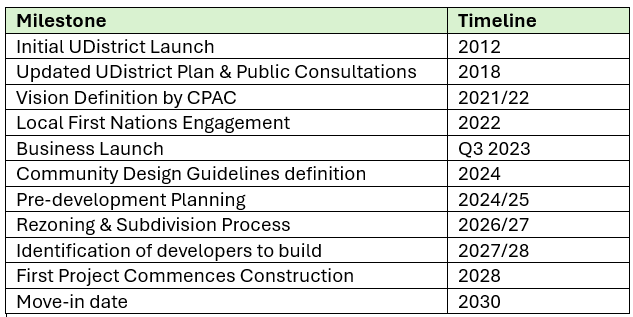
Process and Timeline
The development process will follow the City of Abbotsford’s standard rezoning and subdivision procedures.